|
In preparing for what comes, we give consideration to a great
many different potential problems and disasters:
- fire
- flood
- earthquake
- volcanoes
- disease
- no food
- no shelter, and the list goes on.
In our personal preparations, we are at the point where we have
and will have food and water, as much First Aid as possible, and
our land is "hopefully" at sufficient elevation to be above any
potential flood plain. (4500 feet above sea level) There is no
evidence of volcanic activity nearby, but the potential of earthquake
exists, as it does for most of us. Our house is of block, and
its ability to withstand earthquake isn't too good. It could vibrate
apart easier than a wood frame house. So our thoughts turn to
shelter, just in case.
We have acquired large, heavy duty tarps, parachute cord and if
necessary, we can acquire 20 foot lengths of PVC pipe to make
a frame for a dome shelter. However, wind begins to become an
obvious factor in making a decent shelter, and tarps and plastic
pipe just wouldn't work. What to do?
Ideally, one or a few of those Sea Box type shipping containers
would be great, but at US$4,000+ each, that's not within our grasp
at this time. Wood frames can withstand a great amount of wind,
but they also have their limits. It came to mind that underground would be a good place, but not a cave or mine, since the possibility
of cave-in is pretty good.
My grandparents started to build a house in Connecticut back in
the late twenties, but as they progressed, money suddenly dried
up and all they had was the basement. They took the framing for
what would have been the first floor, and made it into a roof.
My mom grew up in that "underground" house, and even experienced
while there, the worst hurricane that part of the country ever
experienced. While all their neighbors' homes were literally destroyed
by the high winds, my grandparents and family were safe and dry
and warm.
What follows are the plans I have made for a simple box, that
can be put, or more likely built in a hole. Properly covered,
it will withstand a great deal of adverse conditions. Since money
is by no means plentiful in our lives, I planned it as simply
as possible. Once decent shelter is achieved, comforts can be
added as the materials are acquired. I say "acquired" because
more than half of the supplies we have been able to get came from
means other than purchase. This includes:
- framing lumber from the dump
- dried foods that someone no longer wanted cluttering their barn
- the generator we purchased with the proceeds from a motorcycle
we had sitting around collecting dust
- water storage with old water heaters that I stripped, cleaned
and flushed out.
So, in the drawing of these plans, I kept in mind that the materials
for this box may be acquired piece-meal, and the construction
would go accordingly. Here goes.
UNDERGROUND, WATERPROOF? WINDPROOF? EARTHQUAKE RESISTANT? SHELTER
Most of us are physically able to dig a hole by hand with a shovel,
pick and pry bar. The hole has to be about twelve feet wide, by
sixteen feet long. Depth is up to you. The deeper, obviously,
the better. Save what dirt that comes out of the hole, as it can
be used to cover your box. Based upon experience, in packed soil,
with six inch rock, a four feet deep hole took me four days of
unforgettable hard labor. Many hands make for light work. GET
HELP!!
The simplest waterproofing would be by using landscape plastic.
Six mil would be the best. But if that's not available, the heaviest
you can get is better than none. You are going to wrap the entire
box in plastic, then fill in the hole around the box and cover
it also. This is why deeper is better. Before you begin putting
your frame together, line the hole with the plastic. You will
be assembling the frame over the plastic, so be careful not to
puncture it.
The box, as shown in Figure 1, is made up of five ribs, and two
ends.
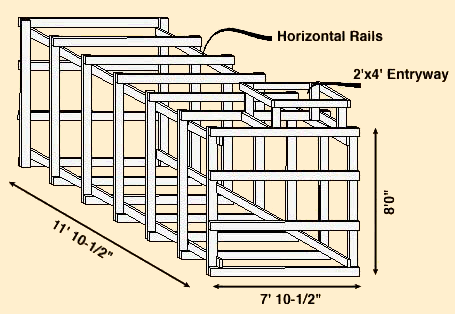
The box will be seven feet, ten and one half inches wide, eight
feet tall, and eleven feet, ten and one half inches long. The
shaft for the entryway is two feet wide by four feet long by two
feet high.
MATERIALS
- 40 -- 2 x 6 - 8'
- 17 -- 4' x 8' x ?" Wafer Board (this is like particle board, but
with larger chunks of wood. It's cheap!!)
Here, in the extreme southeastern corner of Arizona, where building
materials are a little more expensive than the bigger cities,
the above materials priced out at $460.00. This does not include
the hardware to fasten this thing together. A roll of black, 6
mil plastic, 20 feet wide by one hundred feet long is $50.00.
If plastic is not available, no reason why a lot of paint and
caulk won't work just as good. Worse case scenario, and if nothing
is available, don't cover it.
As far as fastening this thing together, if I have power available,
I plan to use 3" deck screws to fasten the 2x6's together and
2" deck screws to attach the wafer board to the frame. If there
is no power, then a good old hammer and nails will have to do.
10d cement coat box nails if possible, for everything. The problem
with hammer and nails is that things tend to vibrate and loosen
with such a frame. Have a good heavy brace on the other side of
what you're nailing, like an eight pound sledge hammer.
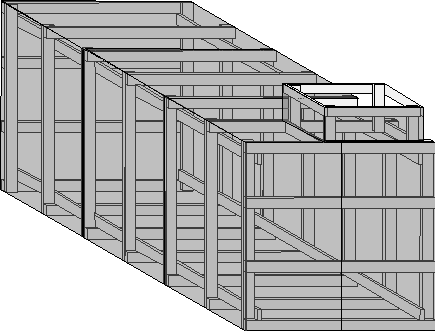
The horizontal members of the ribs and end pieces should be cut
to seven feet, ten and one half inches long. All vertical members
are to be eight feet. This allows for the overlap of the top panels
over the side panels. See Figure 2 below.
Construct the ribs and ends, and using the horizontal rails, fasten
the frame together. Everything must work in two feet increments,
so the panels will match the frame. Be as meticulous as you can
in making the frame square. Everything will fit better, if you
do. Remember that your panels are four feet wide, and must butt
together in the center of the rib.
Once the frame is complete, your panels can be fastened to the
frame. Do one end first, then the sides, working from one end
to the other.
Before you do the remaining end and the top, cut your floor panels
to six feet, ten inches long, place them inside, and fasten them
down. Finish the remaining end.
You can now put the two whole top panels in place, then cut the
last panel to fit around the entryway. The last panel you have
will be used to cover the access way chimney. I did this to help
keep debris from falling inside. Make the hatch cover three inches
bigger than the outside of the chimney, and frame it with the
last 2x6. It will cover the hatch, and fastened down with hook
and eyes, will provide some security.
I deliberately left out any dimensions for the chimney. Measure
and cut to fit.
When you have reached this point, and have a ladder inside for
access, finish wrapping the plastic around everything. Back fill
your dirt around the box and cover it about a foot and a half
on top. Pack it down as best you can so it won't blow away.
The inside can be finished with wood frame bunks for sleeping
and storage. The exposed interior studs are easy to work with.
Whatever frame work you may add inside, fasten it as much as possible,
to the sides, top and/or bottom. This will serve to reinforce
the entire structure.
Since the entire box is covered in plastic, it won't breath very
well. A lot of bodies generate moisture. With no where to evaporate,
this will eventually become a problem in moister climates. The
hatch ventilation may or may not be sufficient.
I have built a few structures similar to this in the past, and
as far as strength is concerned, it is a good plan. If you have
questions, feel free to email me at maxine@c2i2.com. Good Luck!
Doug Smith |