Active, Licensed Low-Level Waste Disposal Facilities
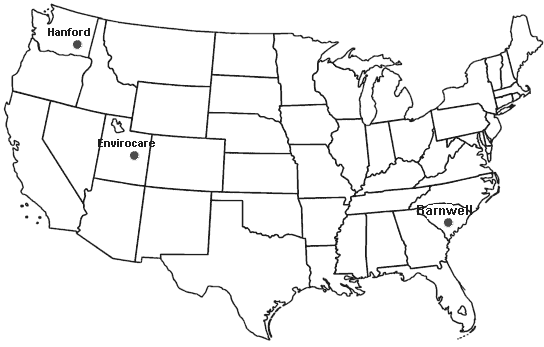
Low-Level Radiation Waste Disposal Sites
Low-level waste includes items that have become contaminated with radioactive material or have become radioactive through exposure to neutron radiation. This waste typically consists of contaminated protective shoe covers and clothing, wiping rags, mops, filters, reactor water treatment residues, equipments and tools, luminous dials, medical tubes, swabs, injection needles, syringes, and laboratory animal carcasses and tissues.
Radioactivity can range from just above background levels found in nature to very highly radioactive in certain cases such as parts from inside the reactor vessel in a nuclear power plant. Low-level waste is typically stored on-site by licensees, either until it has decayed away and can be disposed of as ordinary trash, or until amounts are large enough for shipment to a low-level waste disposal site in containers approved by the Department of Transportation.
Active, Licensed Low-Level Waste Disposal Facilities
* Barnwell, located in Barnwell, South Carolina
Currently, Barnwell accepts waste from all U.S. generators except those in Rocky Mountain and Northwest compacts. Beginning in 2008, Barnwell will only accept waste from the Atlantic Compact states (Connecticut, New Jersey, and South Carolina). Barnwell is licensed by the State of South Carolina to receive wastes in Classes A-C.
* Hanford, located in Hanford, Washington
Hanford accepts waste from the Northwest and Rocky Mountain compacts. Hanford is licensed by the State of Washington to receive wastes in Classes A-C.
* Envirocare, located in Clive, Utah
Envirocare accepts waste from all regions of the United States. Envirocare is licensed by the State of Utah for Class a waste only.
Compacts
These are groups of two or more States formed to dispose of low-level radioactive waste on a regional basis. Forty-two States have formed nine compacts. Their low-level rad waste is then sent to one of the three locations above for disposal. Because this material falls into the low-level category does not mean it's not dangerous. By the NRC's own definition, it can include very highly radioactive materials.

NOTE: Data as of December 31, 2000. Alaska and Hawaii belong to the Northwest Compact. Puerto Rico is unaffiliated. Source: NRC
U.S. Low-Level Waste Compacts
| Compact | Percent of Total Volume of Low-Level Waste Disposed in 2000 | ||
|---|---|---|---|
| Northwest total 4.7% | |||
| Alaska | <.01% | Oregon | 3.55% |
| Hawaii | 0.04% | Utah | 0.16% |
| Idaho | <.01% | Washington* | 0.95% |
| Montana | <.01% | Wyoming | <.01% |
| Southwestern total 1.83% | |||
| Arizona | 0.09% | North Dakota | <.01% |
| California** | 1.73% | South Dakota | <.01% |
| Rocky Mountain total 0.9% | |||
| Colorado | 0.08% | Nevada | <.01% |
| New Mexico | 0.01% | ||
| Midwest total 2.53% | |||
| Indiana | <.01% | Missouri | 0.24% |
| Iowa | 0.03% | Ohio | 2.12% |
| Minnesota | 0.10% | Wisconsin | 0.04% |
| Central total .58% | |||
| Arkansas | 0.18% | Nebraska** | 0.07% |
| Kansas | 0.04% | Oklahoma | <.01% |
| Louisiana | 0.29% | ||
| Texas 1.67% | |||
| Maine | 1.44% | Vermont | 0.06% |
| Texas | 0.17% | ||
| Central Midwest total 2.89% | |||
| Illinois** | 1.76% | Kentucky | 1.13% |
| Appalachian total 13.70% | |||
| Delaware | <.01% | Pennsylvania** | 13.40% |
| Maryland | 0.29% | West Virginia | <.01% |
| Northeast total 8.33% | |||
| Connecticut** | 0.69% | South Carolina | 6.53% |
| New Jersey** | 1.11% | ||
| Southeast total 61.19% | |||
| Alabama | 0.21% | Mississippi | 0.15% |
| Florida | 0.24% | Tennessee | 58.61% |
| Georgia | 0.61% | Virginia | 1.37% |
| Unaffiliated States total 2.51% | |||
| District of Columbia | 0.01% | New York** | 0.70% |
| Massachusetts** | 0.55% | Puerto Rico |
<0.1%
|
| Michigan** | 0.56% | Rhode Island | <0.1% |
| New Hampshire | 0.09% | North Carolina** | 0.60% |
| Unknown*** | 11.1% | ||
Source: DOE 1998 State-by-State Assessment of Low-Level Radioactive Wastes Received at Commercial Disposal Sites (DOE/LLW-252).
http://www.nrc.gov/waste/llw-disposal/compacts.html