|
 PROTECTING YOUR HOME FROM EARTHQUAKES
Part 3
AUTOMATIC GAS SHUTOFF VALVES
For those who want to think about as few details as possible or
if you live in an area that has frequent earthquakes, an automatic
gas shutoff valve might be worth considering. This is an excellent
gadget if you're frequently away from home and live in a quake-prone
zone.
The basic purpose of a gas shutoff valve is to cut the flow of
gas to your house in the event of an earthquake. These units are
installed between the gas meter and your home. Each device has
a simple mechanism inside which, when activated, blocks the flow
of gas. Different manufacturers have their own unique methods
of restricting gas flow, but they all operate essentially the
same way.
For earthquake purposes, be sure to purchase a seismic valve as there are two types: seismic valves and excess flow valves.
Seismic valves are triggered by the ground shaking caused by earthquakes. When shaking reaches the level of the valve's designated shutoff point (people generally set them around 5.2-5.4 on the Richter Scale), the valve automatically stops the flow of gas into your house. Once you have determined there is no potential danger from fire or explosion, reset the valve manually to restart the flow of gas.
Shutoff valves are generally made from cast aluminum and come in various sizes fo fit 3/4", 1", and 1-1/4" pipe. |
 |
PROPANE TANKS
During an earthquake a propane tank can be knocked off its legs
posing the danger of fire or an explosion. Even if it stays on
its legs, jostling can rupture the tank setting the scene for
a fire. The same caution applies for small tanks like those use
for BBQs and camping.
- One way to prevent damage to propane tanks and compressed gas
cylinders is to anchor and brace them securely. This figure shows
how the legs of a propane tank can be braced and anchored. Using
a flexible connection on the supply line will help reduce the
likelihood of a leak.
Compressed gas cylinders, because they have to be periodically
replaced, cannot be permanently anchored. You can use chains to attach them to a wall so that they'll remain upright.
Before altering your propane tank:
1. Make sure you own the tank. Some utility companies only rent
these units.
2. Empty the gas before doing any welding.
3. Check with your propane supplier for any other safety precautions.
|
 |
Clear the area around the propane tank to ensure that there are
no tall or heavy objects that could fall on the tank or rupture the supply line.
Keep a wrench near the shutoff valve and make sure family members
know where it is and how to turn off the supply line if they smell a gas leak.
This is another reason to consider installing an automatic gas
shutoff valve.
Using a flexible connection between the propane tank and the supply
line and where the supply line enters the house is a good idea.
This should be done by a licensed contractor both for safety and
to make sure it meets to codes.
|
 |
Attach compressed gas cylinders to a wall, using two lengths of
chain around the cylinder -- one just below the top of the cylinder
and one just above the bottom. The chains should be secured to
eye hooks screwed into the wall. In wood-frame walls, the eye
hooks must be mounted to studs. In concrete or masonry block walls,
install the eye hooks with expansion anchors or molly bolts.
SHUTTING OFF THE WATER SUPPLY
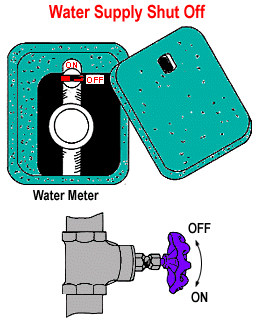
If you know there are leaks after an earthquake, you can shut
off all the water in your house. Locate the main water service
pipe into your house (probably in the front at the basement level
or near the street or sidewalk). Many water utilities set their meters and shutoff valves into
a shallowly buried concrete case. Open the cover with a long screwdriver or specialty tool. There will be a gate valve on the pipe. The valve can be operated
by a water main wrench or crescent wrench. If this box is inaccessible
or you can't find it, call your water department. Paint the valve
so it's easy to find in an emergency.
It's a good idea to locate it before an emergency.
If your box is buried deeply or set into a berm, you may need
to purchase a long handled water main wrench from your local hardware
store. They cost about US$15 - 25. Even if your water main shut
off is easy to reach, these wrenches make the job easier.
Don't let the word "wrench" throw you when looking for this item.
These wrenches come in varying lengths, typically four or five
feet, and resemble a steel pipe about 1-1/2 inches in diameter.
|
|
|
. |
 |
ADDITIONAL HELP
Two other free sources of information for protecting your home
can be found on the Internet.
San Leandro's (California) award winning guidebook describes easy
and low-cost ways to make your home safer in earthquakes. 3 Easy Low Cost Ways To Make Your Home Earthquake Survivable can be download in its entirety in PDF or choose certain sections.
This 16 page booklet has excellent photos which clearly illustrate
what to do. http://www.abag.ca.gov/bayarea/eqmaps/fixit/training.html
FEMA has funded the development of materials to train contractors
and building inspectors on how to perform common earthquake retrofits
for single family homes. Don't let it frighten you that the material
is for contractors. Most handy people should be able to understand
the information since it's training material for these folks.
Included are both a manual and a slide presentation. The ENTIRE
Manual is available as Adobe Acrobat files, and via ftp as MS
Word files. The slide presentations are available as html presentations,
and via ftp as PowerPoint files. http://www.abag.ca.gov/bayarea/eqmaps/fixit/training.html
Another helpful web site is the Home Building Manual with this
very useful Construction Glossary http://www.HomeBuildingManual.com
SCRUMPTIOUS SKIES - AGAIN!
-
Maybe as a kid I wasn't looking up often enough or else lived in the wrong place, but do you remember seeing auroras this frequently in so many locations around the world and in these gloriously vivid hues? They make NBC's peacock look like an ugly duckling!
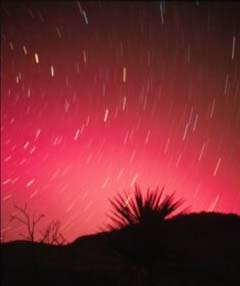
Right on the heels of April 11th geomagnetic storm, we have yet another CME hurtling toward Earth. This CME rocketed out of an X2 class flare and the resulting storm should impact Earth today, Saturday. Like last week, people living in latitudes higher than ~50o should have the best viewing.
However, this stunning photo (right) snapped by Chris Grohusko, near the New Mexico - Texas border is remarkable since it shows the auroras dipped much lower than expected. Maybe they will this week too.
|
|
|
Click photos below for larger image
|

|

|
|

|
Garth Arsenault, Prince Edward
Island, Can.
April 11, 2001
|
Harald Edens, Wijdenes,
The Netherlands
April 11, 2001
|
Thad V'Soske, Anza-Borrego Desert
State Park,
s. California
April 11, 2001
|
Morton Henderson,
Glasgow, Scotland
April 12, 2001
|
- All aurora photos copyrighted to the photographer.
-
- With affection,
- Holly and Stan
Seismo and Taco
Seismo: "Hey, Taquita, looks like The Parents are planning a quake-safe party in the gazebo today!"
Taco: "A what?"
Seismo: "Well, look over there. Mom's putting that sticky stuff under the wine glasses on the picnic table."
Taco: "You Doofus!.... See those smoked bones and those Kentucky Fried Chicken strips in our bowls by the table? They're getting ready to have an Easter picnic with us!"
Seismo: "Gosh... hmmmm.... but why are they anchoring the picnic table to the ground if they are aren't having a quake-safe party?"
Taco: "You really don't know, do you, Seisy?.... Your name is short for seismograph!" <smile>
- Stan and Holly Deyo
In Colorful Colorado!
http://millennium-ark.net/
© Text and Graphics, 2001 Stan and Holly Deyo, except where otherwise credited
Sources:
1Adapted from Natural Resources Canada; http://www.seismo.nrcan.gc.ca/prepare/eqresist_e.html
2How Safe Is Your Home?; EQE International; http://www.eqe.com/publications/homeprep/howsafe.htm
The Journal of Light Construction; Seismic Support For Old Foundations;
by John Scoggins; June 16, 1999;
3(U.S. Army Corps Of Engineers; South Pacific Division; Earthquake
Preparedness Center of Expertise; Family Preparedness Brochure;
http://www.spn.usace.army.mil/readiness/brochure.html
http://www.jlconline.com/jlc/archive/foundations/seismic_support/index.html
Dams & Earthquakes; Seismology Research Centre; http://www.seis.com.au/Basics/Dams.html
University of Alaska Fairbanks; How To Reduce Earthquake Damage;
http://www.uaf.edu/
|


