DAFFY DOGS AND FREAKED FELINES
You may want to purchase a plastic airline container or collapsible wire crate to transport your dog or cat. It makes for more peaceful nerves for all concerned. Be sure the crate is large enough for your dog or cat to lie in comfortably. Food and water bowls can be purchased that snap onto the wire door. Above each water container on the outside of the wire door, we attached a small flexible funnel. Push the funnel tip through the mesh so the tip sits 1/2 inch inside the water bowl. This
allows you to refill their water without opening the door - a great idea if the animal is stressed and eager to bolt. Bowls snapped onto the cage also help eliminate spilling and allows more room for stretched out snoozing. When Taco isn't drinking from hers, she uses it as a chin rest. Guess she's not too fussed about dog hair in her water!
We purchased these two Petmates from VariKennel, but there are
numerous other manufacturers. Most models break down in seconds
for easy storage by unscrewing a few bolts around the middle.
|

Taco left, indignant at first to be sitting in "doggy jail". Seismo,
right, resigned himself early to Fate. Now they're both at ease
traveling in these containers.
|
Since Taco and Seismo are still over at the "doggy Hilton" while
we're in the motel, we've used these airline approved travel crates
quite a bit. On Saturdays we've been taking them to the mountains
on picnics. Taco has a touchy stomach and tends to get car sick
without an anti-static strap attached. Since we now have a car
(no pickup) we were extra careful the little darlin' didn't throw
up on the carpet. Only having the car a few days and no tools,
we hadn't attached her anti-static strap yet. Before leaving for
the San Isabel Mountains, we lined their travel containers with
newspaper, "just in case". Sure enough, it was good planning.
Taco must have been green under all that fur. The newspaper-lined
VariKennel caught the mess. Poor baby. By the next weekend, we
had her "anti-barf" strap installed!
STAKES AND TIE-OUTS
Another idea is to purchase a metal stake for dogs that screws
into the ground. To use, snap the chain to the dog's collar and
you can rest easy they're secure. Make sure you purchase a heavy
enough stake so that they can't pull it out of the ground. Be
sure to use a chain and not a leash so it can't be chewed through.
Sadly, we have heard many instances where people left their dogs
chained on porches and hung themselves by either slipping through
the rails or falling through the stairs. Make sure the metal stake
is located away from hazards (including aggressive animals) and
has protection from the elements.
|
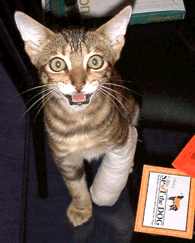
Photo by Joshua Rosenblatt
|
FIRST AID KIT
Check with your veterinarian to find out what he/she recommends you include in your first aid kit. Suggested items include:
QTY
|
FOR DOGS and CATS
|
|
1
4
4
1 roll
1 roll
1 sm. box
1 pkg.
1 tube
1
1
1
1 each pet
4 pair
1
1 each dog
1 tube
3 months supply each pet
1 set each pet
|
first aid book for cat or dog
conforming bandage (3" x 5" - 7.6 x 12.7 cm)
absorbent gauze pads (4" x 4" - 10 x 10 cm)
absorbent gauze (3" x 1 yard - 7.6 cm x 1 m)
medical tape (1" x 10 yards - 2.5cm x 10 m)
cotton swabs
antiseptic wipes
emollient cream like Panalog
tweezers
scissors
nail clippers
instant cold pack
latex disposable gloves
rectal thermometer
proper fitting muzzle (dogs only)
hair ball medicine (cats only)
any medication you pet uses regularly
medical records, including vaccinations
|
PICTURES
Keep current pictures of your dog or cat in case your pet gets lost during the disaster. Be sure to include yourself in some of the pictures in case you have to show proof of family membership.
TOYS
Like with people, familiar things are comforting during stressful
times. Pets get bored easily especially if he is the only animal
and his master is busy coping with the emergency at hand. Toys
and treats will take your pet's mind off the upheaval by giving
him something to keep him occupied. Even if he doesn't play with
it, the familiar scent gives a feeling of continuity.
|
 |
DISASTER PREP FOR BIRDS
Here are the supplies that you should have in a disaster kit for
birds. Adjust the amounts, depending on the number of birds that
you have.
FOOD
Keep at least a two week supply at all times. Your feathered family
member is likely to be stressed during a disaster so store the
brand of food your bird is used to eating. Store food in an air
tight, water proof container and rotate supplies at least every
six months.
GRAVEL
Keep at least a two week supply at all times for birds that need
this product.
CUTTLE BONE AND/OR BEAK CONDITIONER
Always have an extra one on hand.
|

|
WATER
Keep at least a two week supply at all times. Store water in plastic
containers and keep in a cool, dark place. Rotate stored tap water
at least every six months.
CLEANING SUPPLIES AND PAPER TOWELS
Store disinfectant and paper towels to clean your bird's cage.
Have at least a two week supply of whatever it is you put on the
bottom on the bird's cage (i.e., newspaper, butcher paper, gravel
paper, etc.).
EXTRA SEED BOWLS AND WATER CONTAINERS
Have several seed cups and water containers to replace ones that
might get broken. You may want to put an extra food and water
dish in the cage, so that in case you forget to feed the bird
in all the confusion, the bird will have plenty of food and water.
FIRST AID SUPPLIES AND BOOK FOR BIRDS
Check with your veterinarian to find out what he/she recommends
you include in your first aid kit. Some suggested items include
- Kwik Stop or cornstarch to stop bleeding, tweezers, heavy duty
gloves for handling the bird if it is injured and tries to bite
and bandaging materials.
If your bird is on long term medication, be sure to have at least
a two week supply on hand.
NET AND TOWEL
In case you must recapture your bird, store a long handled net
with small enough mesh so your bird can't poke his head through.
A heavy towel or blanket large enough to cover the cage will supply
the necessary warmth should disaster strike when it's cold.
EVACUATION CAGE
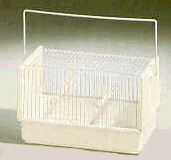
Purchase a small cage for transporting your bird and be sure it
is one that your bird can't chew through. Make sure your cage
is secure. All doors, removable top or bottom should be fastened
to prevent accidental opening during a disaster. Twist ties or
metal rings can be used to secure the cage. Fastening the cage
to a wall with a hook and eye could be very helpful. Keep in mind
any objects that might fall during a disaster and be sure to keep
the cage away from windows that might break during a disaster.
Keep pliers and wire in your disaster supplies to repair the cage
after a disaster.
|
|
FLASHLIGHT AND EXTRA BATTERIES
A flashlight will regulate the light hours for your bird, which
is important for your birds health.
PICTURES for I.D.
Take some recent pictures of your bird, including any distinguishing
marks or coloring. Include yourself in some of the pictures for
proof of ownership.
Microchipping is also a clever idea since birds can't wear collars
and tags. Your veterinarian can provide more information about
this permanent form of I.D.
TOYS
If your bird has special toys he likes to play with, keep a duplicate
set with his emergency supplies. |

|
Continue
© Text and Graphics, 2001 Stan and Holly Deyo, except where otherwise
credited
|
