ARSENIC IN MY DRINKING WATER?
Since many people are uprooting and moving these days, it is prudent
to factor into your relocation site the purity of local ground
water. This affects city, urban, suburban and city dwellers -
anyone whose water is supplied from the ground. One might not
think many people in the US depend on groundwater, but roughly
42,400,000 people (accounting for about 3,350 million gallons
per day) are served through domestic supply; and about 91,200,000
people (accounting for about 15,100 million gallons per day) are
served through public-water supply.
Arsenic is a toxic substance you can neither taste, smell or see
in small enough quantities. It occurs naturally in the ground
and is found in highest concentrations in the U.S. West, in parts
of the Midwest and Northeast. It is particularly common near old
mining areas.
Recently the United States has proposed to adopt the same standards
recommended by WHO (World Health Organization) to LOWER the acceptable
amount of arsenic for consumption from 50 micrograms per liter
(roughly a quart) to only 10 micrograms per liter. This is an
80% reduction which tells us Americans may have been consuming
far too much arsenic. This lower ten micrograms per liter is standard
in Australia. This new standard will be formally proposed June
2000 and finalized in 2001.
The reason for the proposed reduction of arsenic in water is the
cancer connection. Arsenic is known to contribute to skin, lung,
liver, kidney and bladder cancers. "Consuming arsenic in drinking
water also can cause skin lesions, anemia, nerve damage and circulatory
problems. Arsenic is readily absorbed from the gastrointestinal
tract into the blood. The mechanisms through which arsenic causes
cancer are not well-understood, but data suggest that arsenic
probably causes chromosomal abnormalities that lead to cancer."
http://unisci.com/stories/19991/0326991.htm It has also been reported to affect the vascular system in people
and has been associated with the development of diabetes. (USGS
press release)
In April 2000, Stan and I watched an Australian "60 Minutes" segment
showing the results of high levels of arsenic in the water of
Bangladesh. First people's hands and feet blistered and then blackened
- especially the feet and legs. When the gangrene set in, the
feet and limbs have to be amputated. It is not as though these
people have a choice for clean drinking water. They can't boil
it as wood is too scarce. Their only other alternative is the
filthy flood water used for bathing, cooking, washing and waste
removal. Garbage abounds as does cholera. That is their choice:
dysentery and faster death, or arsenic and a slower, cancerous
death. If was very difficult to watch young adults become multiple
amputee victims.
In view of this concern, the USGS has collected and analyzed arsenic
in potable (drinkable) water from 18,850 wells in 595 counties
across the United States during the past two decades. These wells
are used for:
- public and private water supplies
- irrigation
- industrial purposes
- research
USGS has put together a general map indicating areas affected
with too-high concentrations of arsenic can be found.
Click map on the right for larger image. |
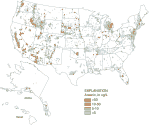 |
Approximately 10% of the samples in the USGS study exceed the
WHO guideline. Even with this extensive testing, it does not cover
every well and water source.
This USGS map breaks out the affected areas by county and color
coded for severity.
Click map on the right for larger image. |
 |
How frequently are arsenic concentrations in ground water likely
to exceed the proposed new maximum contaminant levels?
To look at the Nation as a whole, arsenic data were grouped by
county and linked to the number of public-supply systems withdrawing
ground water in each county (Focazio and others, 1999). Estimated
percentages of small, public water-supply systems that withdraw
ground water exceeding six arsenic concentrations are shown in
figure 2. Systems were called "small" if they served between 1,000
and 10,000 persons. Focazio and others (1999) provide similar
information for both smaller and larger sized systems. The highest
concentration evaluated is at the current MCL of 50 µg/L, along
with several lower concentrations, one of which may become the
new MCL.
As the concentration for a possible new MCL decreases, the likelihood
of exceeding that standard increases. Just over 13 percent of
systems used water with arsenic concentrations greater than 5
micrograms per liter, compared to fewer than 1 percent exceeding
the current 50 µg/L MCL. Public systems exceeding a new, lower
MCL will be required to either treat their water or find alternative
sources of supply. This choice undoubtedly will increase costs
for consumers while decreasing their exposure to arsenic. Although
homeowners with private wells are not regulated, a lower drinking-water
standard would mean that more homeowners will be consuming water
with concentrations that exceed a standard.

This chart shows the estimated percentages of U.S. public water-supply
systems using ground water exceeding six arsenic concentrations.
For systems
serving between 1,000 and 10,000 people.
If you are concerned about the possibility of arsenic in your
groundwater, one alternative is to take a sample into your local
water department and ask them to run a check specifically for
arsenic. If you aren't sure where your water department is located,
contact the public health department. Another option is to contact
your local USGS office. http://water.usgs.gov/wrd002.html lists local USGS state representatives by state accessible it
through the interactive map provided.

